Publica tus comentarios, quejas, sugerencias, anécdotas o lo quieras decir al concho o a la comunidad universitaria enviándolo vía e-mail a la dirección que aparece aquí arriba, es decir:
Two of the primary initiatives the foundation staff has been working on over the past few months were the two back to back Global AppSec Events in DC and Amsterdam. This was a huge undertaking by everyone involved. We are pleased to announce that the survey feed back is positive and both events were well attended. I was in attendance of Global AppSec Amsterdam and it was great meeting and speaking with old friends and meeting new ones. I would also like to take this opportunity, on behalf of the board to thank OWASP staff for their efforts in making the two conferences so successful.
To continuing on with the events theme; I'm really happy to announce the locations of our 2020 OWASP Global AppSec Conferences. The first one will be June 15 - 19, 2020 in Dublin and the second will be October 19 - 23, 2020 in San Francisco. Dublin is not an exotic trip for me, more of a 10 minute tram ride. Hopefully you will join us, while also making the most of the culture and scenery that Ireland has to offer.
Last but not least, the OWASP Global Board of Directors election results where released Thursday October 17, 2019. I'd like to first thank everyone who has put their trust in me by voting me back onto the board for the next two years. I hope I do you justice.
I would also like to thank the large number of candidates that were willing to give of their personal time and run to be part of the Global OWASP Board. This is a testament of the dedication and commitment of our members to continue to grow and evolve to the next level as an organization. I encourage those that were not elected will still be involved in making a positive change by volunteering to be part of a committee. The board and staff need all the help they can get to push through change. I hope you will join us in this journey. We can not be successful without the help of the community.
Until next time, Owen Pendlebury Vice Chairman, OWASP Global Board of Directors
OWASP Global Board Election Results
The newly elected 2020 OWASP Board Members: Grant Ongers Owen Pendlebury Sherif Mansour Vandana Verma Sengal
Congratulations, and thank you to all the candidates that participated and the OWASP members that voted.
OWASP Foundation Global AppSec Event Dates for 2020
Global AppSec Dublin, June 15 - 19, 2020
Global AppSec San Francisco, October 19 - 23, 2020
BlackHat Europe 2019 London at EXCEL London 2019 December 2-5 Visit the OWASP Booth 1015 Business Hall December 4 & 5 December 4, 10:30 AM - 7:00 PM December 5: 10:00 AM - 4:00 PM
Projects were well-represented at the previous two Global AppSec conferences in DC and Amsterdam this past month. Both events featured the popular Project Showcase and I heartily thank the leaders of the projects who participated:
Secure Medical Device Deployment Standard Secure Coding Dojo API Security Project Dependency Check SAMM SEDATED DefectDojo Juice Shop ModSecuity Core Rule Set SecurityRAT WebGoat
These leaders put on a great set of presentations and, in many cases, the room was standing room only. Thank you!
The project reviews that were done in DC and Amsterdam are still being evaluated and worked on; if you are waiting on answers, please have patience. I hope to have them finalized by November.
The website migration continues moving forward. The process of adding users to the proper repositories is an on-going effort. If you have not given your GitHub username, please drop by the Request for Leader Github Usernames form. A nice-to-accomplish goal would be to have the projects and chapters in their new website homes within the next 30 days.
Harold L. Blankenship Director of Technology and Projects
COMMUNITY
Welcome to the New OWASP Chapters Sacramento, California Marquette, Michigan Ranchi, India Paraiba, Brazil Calgary, Canada
CORPORATE MEMBERS
Premier Corporate Member
Contributor Corporate Members
*Ads and logos are not endorsements and reflect the messages of the advertiser only. *
A bug bounty program, also called a vulnerability rewards program (VRP), is a crowdsourcing initiative that rewards individuals for discovering and reporting software bugs. Bug bounty programs are often initiated to supplement internal code audits and penetration tests as part of an organization's vulnerability management strategy.
Many software vendors and websites run bug bounty programs, paying out cash rewards to software security researchers and white hat hackers who report software vulnerabilities that have the potential to be exploited. Bug reports must document enough information for for the organization offering the bounty to be able to reproduce the vulnerability. Typically, payment amounts are commensurate with the size of the organization, the difficulty in hacking the system and how much impact on users a bug might have.
Mozilla paid out a $3,000 flat rate bounty for bugs that fit its criteria, while Facebook has given out as much as $20,000 for a single bug report. Google paid Chrome operating system bug reporters a combined $700,000 in 2012 and Microsoft paid UK researcher James Forshaw $100,000 for an attack vulnerability in Windows 8.1. In 2016, Apple announced rewards that max out at $200,000 for a flaw in the iOS secure boot firmware components and up to $50,000 for execution of arbitrary code with kernel privileges or unauthorized iCloud access.
While the use of ethical hackers to find bugs can be very effective, such programs can also be controversial. To limit potential risk, some organizations are offering closed bug bounty programs that require an invitation. Apple, for example, has limited bug bounty participation to few dozen researchers.
Reiner Knizia is one of the biggest names in game design around the world. The German game designer is a mathematician and has his name associated to more than 700 games launched in many different countries. I had the honor to talk personally to Knizia in 2011, at DIGRA's conference in Hilversun (Netherlands) and I watched a great keynote about the game designing process in the same event.
On that occasion, I gave Knizia my board game, YN, and had the opportunity to talk a little bit with him (a great achievement for my game designer career).
I follow Knizia in social media and I'm always taking notes about the knowledge on game design he shares on those platforms. In this post, I will reproduce 10 ideas Knizia showed recently on Twitter about playtesting (one of the most fundamental topics in the game designing process). Below, I listed the 10 points. Follow him by clicking here.
Playtesting 1. Those who do not play do not live. Those who do not playtest do not design.
Playtesting 2. Designs always work perfectly in your mind. The first playtest is the (often cruel) moment of truth.
Playtesting 3. Regardless of how much experience you have, you cannot develop a game on the drawing board – only at the playing table.
Playtesting 4. Game design is a classic iterative process of playing and improving – nowadays popularised as "design thinking".
Playtesting 5. When your playtesters do not like your design, (usually) your design is to blame – not your playtesters.
Playtesting 6. I recognise good playtesters by my (frequent) urge to strangle them.
Playtesting 7. For your design to appeal to one group, test with one group. For your design to have broad appeal, test with many groups.
Playtesting 8. You can make (most) designs interesting through your play-talk - but when published, your design needs to speak for itself.
Playtesting 9. Blind playtesting, without you taking part, is as useful as other people going on a rollercoaster and reporting their experience.
Playtesting 10. When you have playtested your design to perfection, let it rest some time, then play again. – Expect to be surprised!
Around a month ago I had an idea in my head: a voronoi grid modified to have rounded cells that change in size. I made an attempt here for single cells changing size. The next step was to merge cells together, as I had done on this project. I decided that the way to demo this would be to simulate some kind of belief/cultural systems that spread over time across a map. I tried this here.
Simulation
It didn't go well.
What happened? I think the problem was that I had three unknown elements in this project:
Simulation with the simplest rendering code I could get away with. Figure out what simulation rules are interesting and cool.
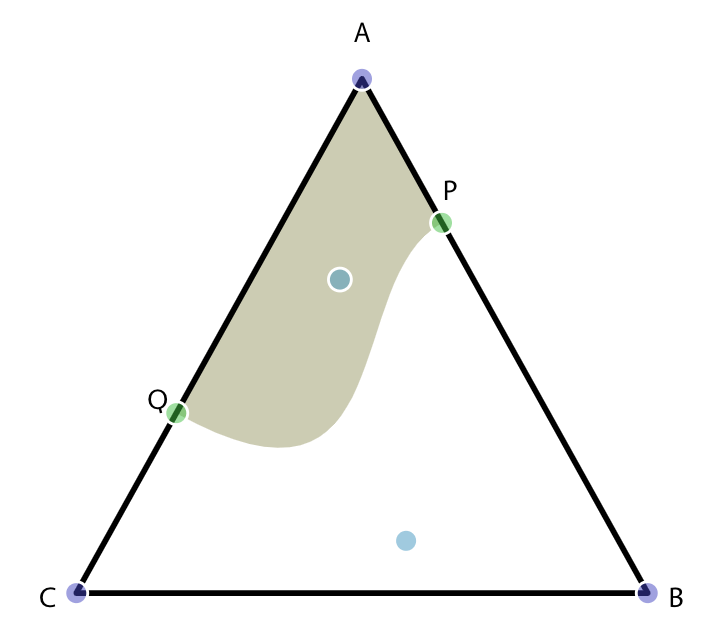
Rendering isolines on a triangle mesh.
Rendering curved isolines on a triangle mesh, using Bezier curves.
In trying to figure out all three at once, I didn't do a good job on them. I should have instead focused on one at a time. I ended up succeeding with #2 when I learned about and implemented the Meandering Triangles algorithm, and also built a little interactive visualization that helped me understand how the algorithm works. I failed with #1, having tried several algorithms but not finding one that I liked. I realized towards the end of the week that #1 was a red herring; I didn't need a simulation at all, as I really just wanted curved regions. I also failed at #3, having tried some experiments but never finding what I wanted, and also rejecting Chaikin Curves for reasons I can't remember. Since I really wanted the curved variable sized regions, I should have spent more time on #3 and less on #1. I ran out of time on this project so I'll leave #1 and #3 for another day.
Para postear un comentario en el blog, hay que enviar un correo a la dirección que ya hemos mencionado 2 veces. El TÍTULO del post será lo que escribas en ASUNTO; si quieres pegar FOTOS, solo tienes que adjuntar los archivos, procura que no sean muy grandes; y el TEXTO, osea tu comentario o lo que sea, solo tienes que escribirlo como cualquier otro correo. Y si te interesa, puedes checar tu redacción y ortografía antes de mandarlo.